The Problem
Pricebook Pro is a pricing and service catalog tool that helps contractors standardize services and pricing across their business. While powerful, onboarding to Pricebook Pro has historically required hands-on support from a Growth Product Specialist, which created long wait times and inconsistent onboarding experiences wait times, which led to customer frustration.
The product had no path for a customer to succeed on their own.
Research
We spoke with our Growth Product specialists and reviewed customer support patterns to understand where setup was breaking down.
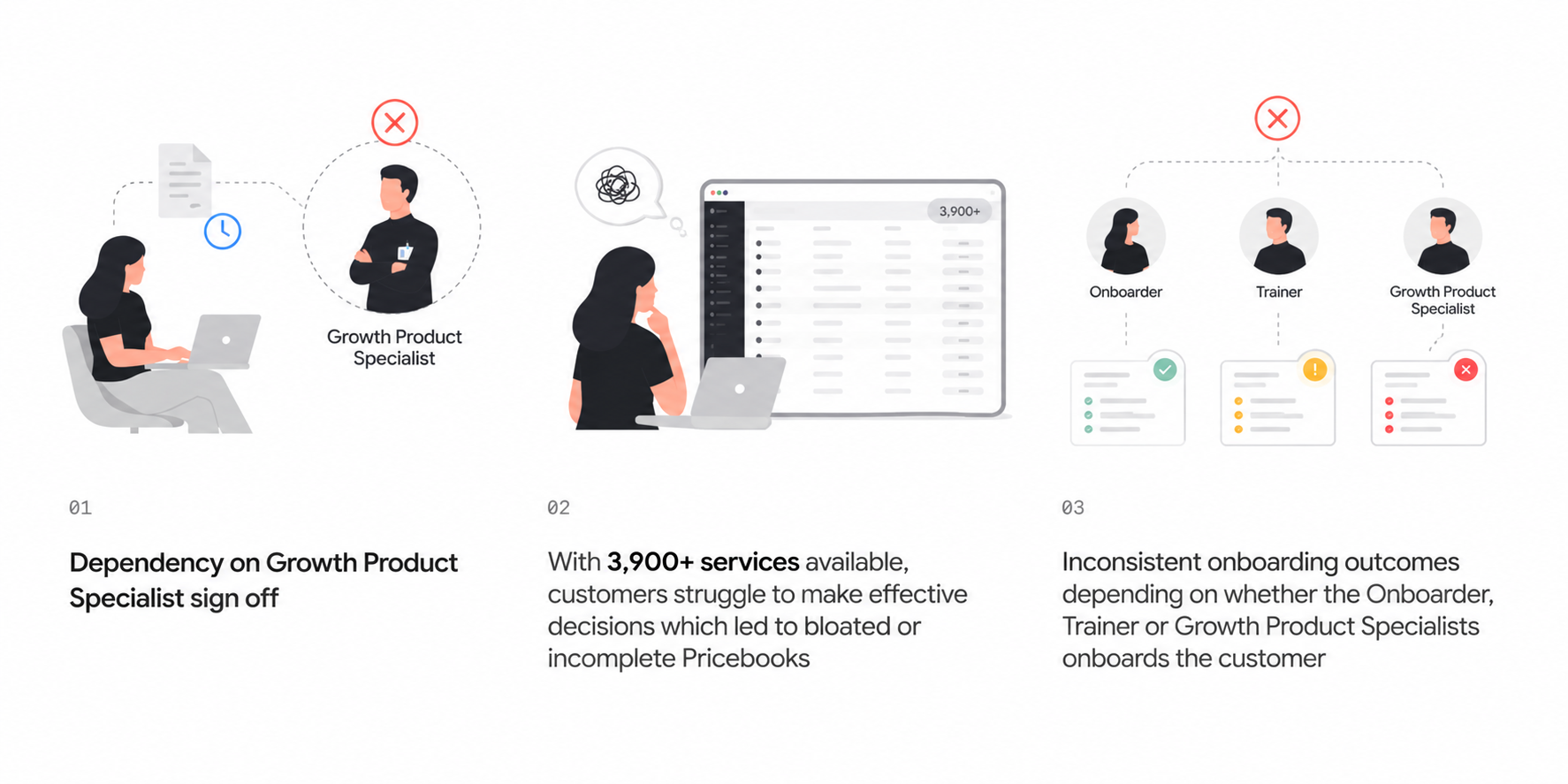
These insights drove the prioritization features that aligned with the Business
- Improve onboarding consistency and customer satisfaction
- Reduce churn risk
- Increase adoption of services & items
- Reduce onboarding related escalations
How might we onboard our B2B customers without needing live suppo
rt?
User Testing
After initial designs, moderated testing with 5 customers validated the need for simplicity as it revealed a long onboarding was cumbersome and caused decision fatigue
-
01
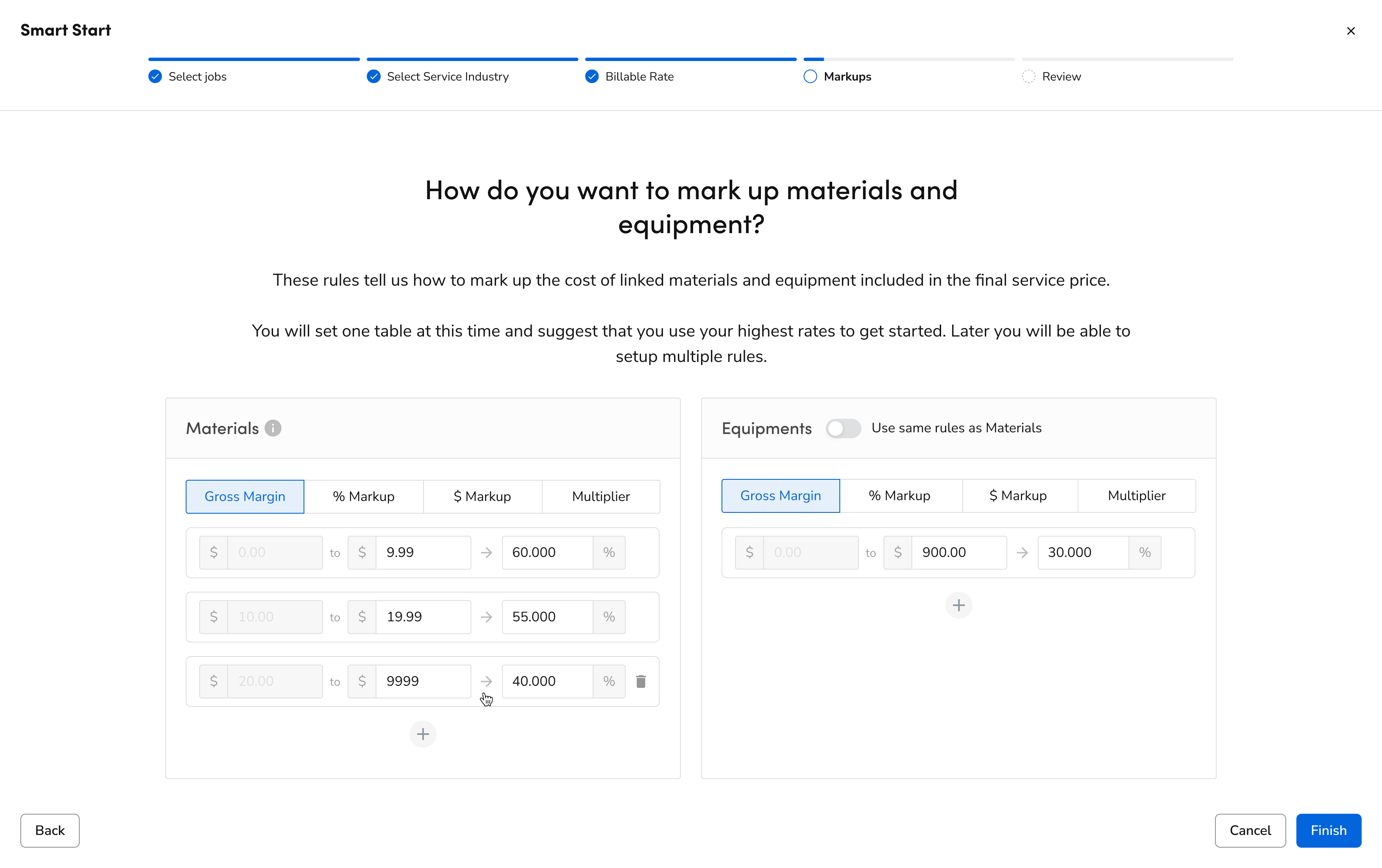
If it was information they didn’t know at hand, they want to be able to skip it, or they would drop from the flow completely. Customers did not need to fill out details like material markup or margins
-
02
Titan intelligence wasn’t prominent enough as a trsust signal to show this was all that was needed to get started.
-
03
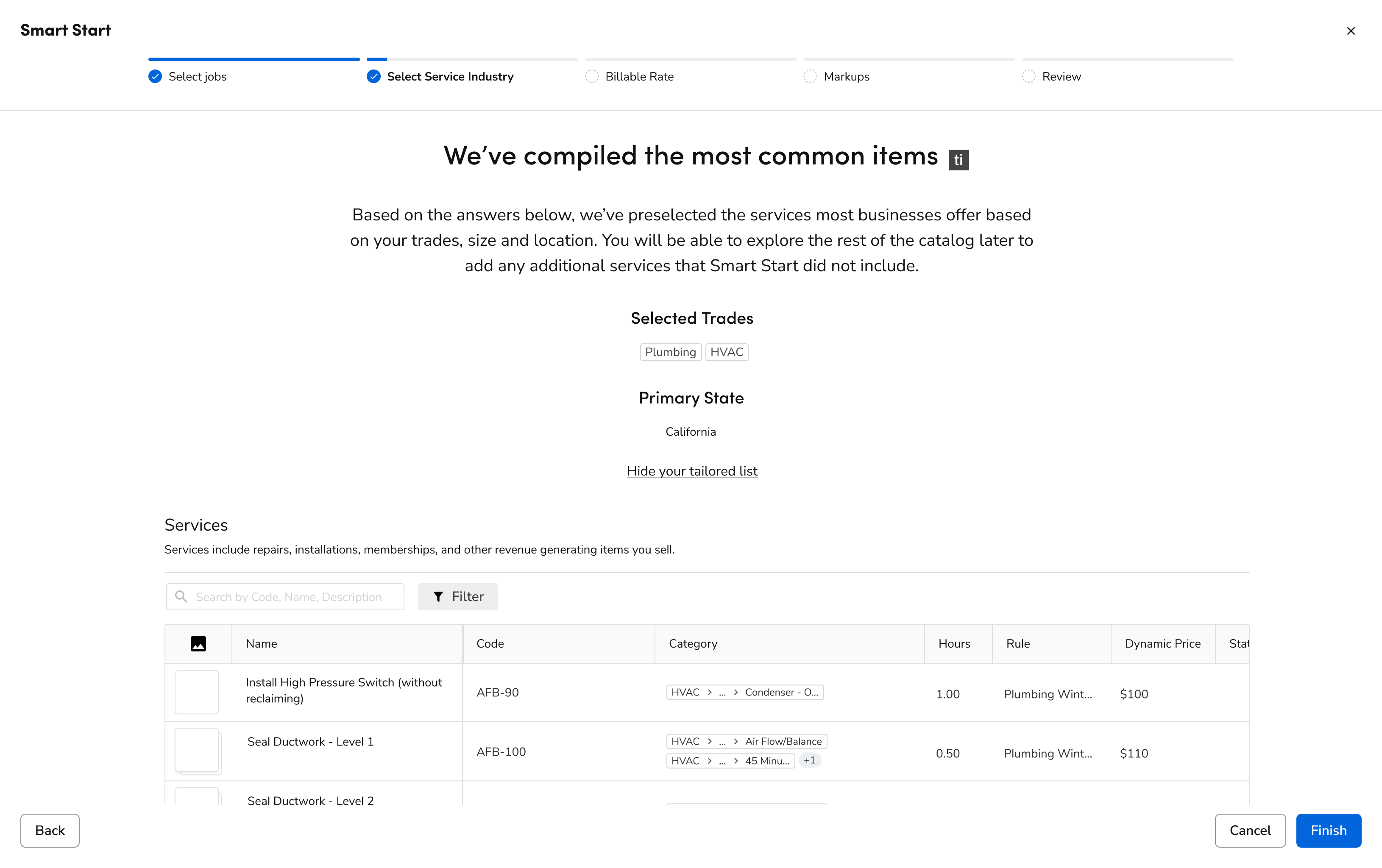
Viewing the entire Pricebook catalog was too much to go over for the first time here.
Solution
I led design on Smart Start, a guided onboarding flow that let customers configure a production-ready Pricebook, guiding users forward with confidence and reducing decision fatigue without a specialist. Along with my PM, we conducted 5 moderated testing sessions to get feedback and refine the overall workflow.
Decision 01
AI-driven suggestions as a trust signal, not just automation
Customers faced with a blank pricing setup tend to stall out and procrastinate rather than guess. By grounding pricing suggestions in real market data, customers had a confident starting point to act on rather than guessing and losing out on potential revenue.
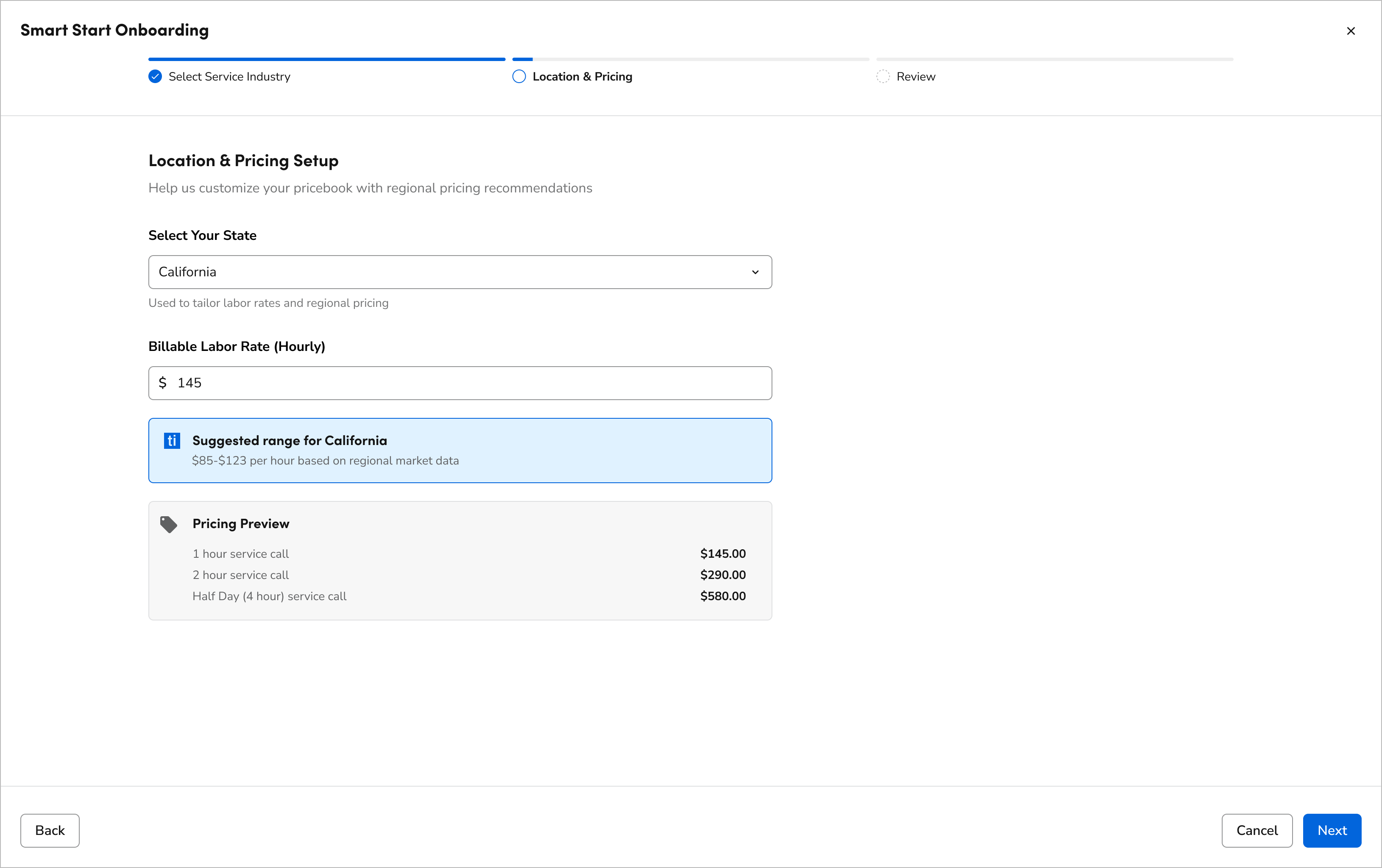
Suggested pricing guide backed by market data per region aggregated by thousands of ServiceTitan Customer data.
Decision 02
Reduce decision fatigue through curation, not just choice
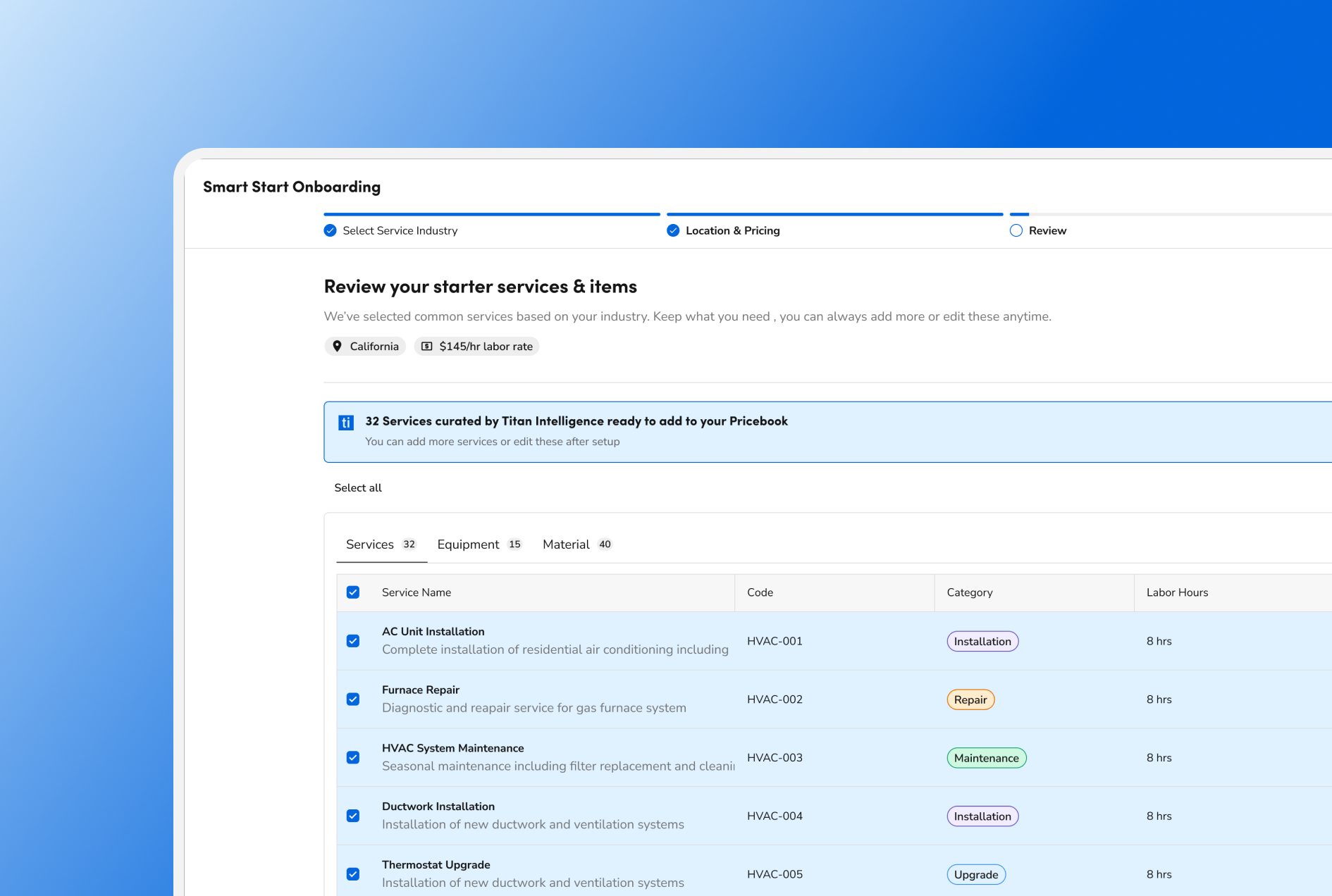
Rather than asking customers to build their service catalog from scratch, the flow pre-selects relevant services by industry and region, with clear reasoning for why each was recommended and the ability to edit anytime — reducing decision fatigue for a first time user.
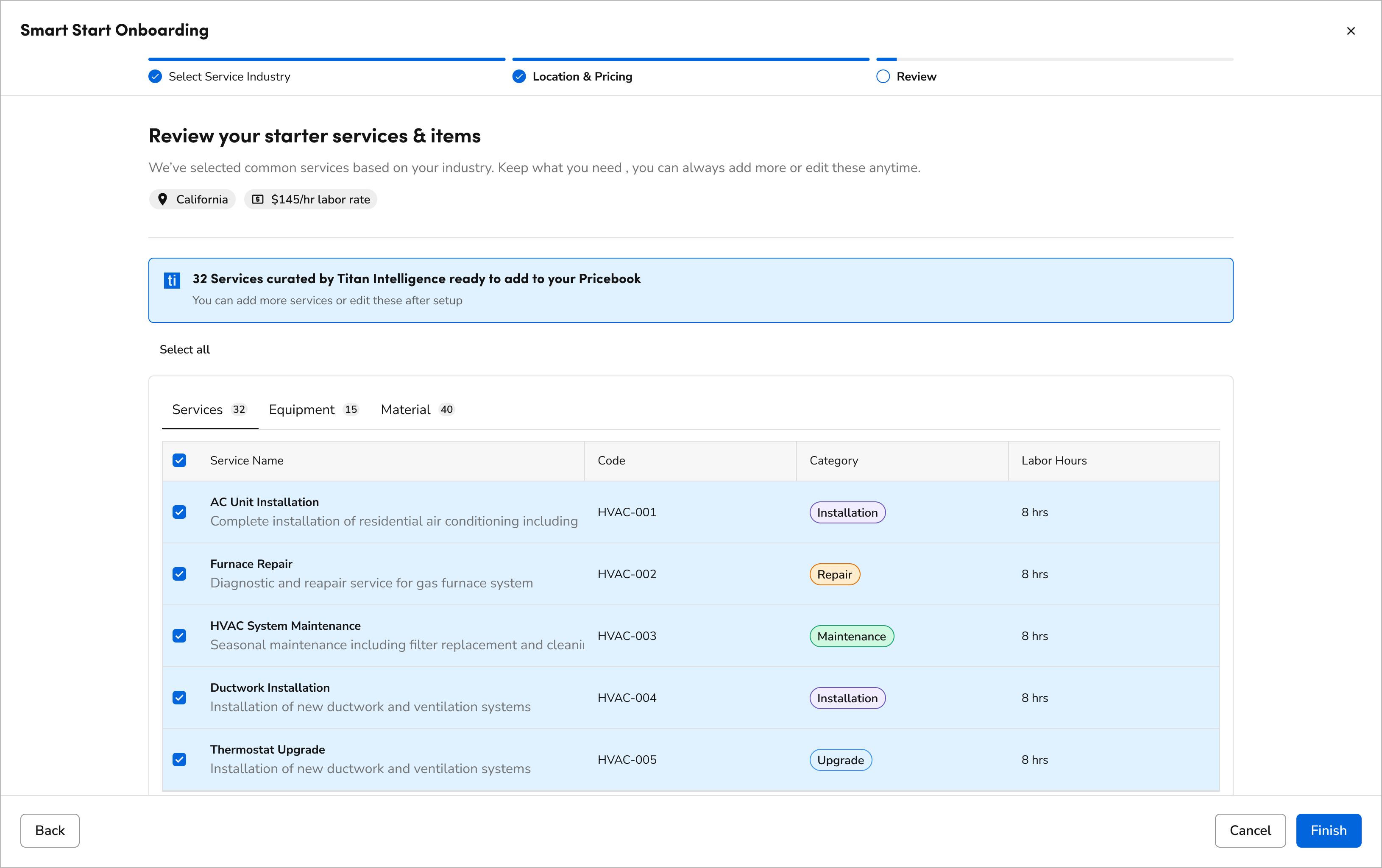
Reviewing pre-selected services for Smart Start Onboarding
Decision 03
Keep specialists in the loop without blocking critical path
Removing the live support dependency didn't mean removing support, it meant redesigning where it lived. Building standardized in-product help and documentation customers could return to on their own, at any step, removing the need for live product support help.

Help guide which can be revisited at any time
Final Design
Challenges & Constraints
-
01
GPS booking integration I had an initial idea at the end of the flow to book time directly with a Growth Product Specialist, like a Calendly experience. After talking it through with my PM and eng, it wasn't easily feasible due to time constraints and GPS scheduling constraints that made this difficult to scale. Instead, we provided a direct email pathway to GPS support within the help guide.
-
02
Reusing the existing Pricebook table Engineering wanted to reuse the existing Pricebook table to save time on designing a new flow, but I pushed back — we didn't need all the information associated with it, and it would have overloaded the user at a critical decision moment. I also argued for a modular design in the next iteration that could support AI-driven recommendations.
Outcome
This project transformed onboarding from specialist-dependent into a scalable design system: faster customer activation, more consistent onboarding, reduced operational strain on Growth Product Specialists, and improved technician productivity in the field.
- Faster time-to-value for Pricebook Pro customers — 45 days to 7 days
- Improved customer satisfaction and confidence during setup
- 23% drop in onboarding-related escalations